
In My Homeland: The Conference For Teachers-Artists Was Held In Minsk
Traditionally, upon completion of the contests juries work within the International Art and Ecological Project "In My Homeland", artists and teachers exchange opinions on topical issues of art education within the framework of the conference "Modern Art Education for Children and Youth". In 2026, the conference was held for three days from 5 to 7 February at three venues in Smolevichi and Minsk.
The conference began with a resulting review on February 5 in the Smolevichi Sport Hall where works awarded with I and II Degree Diplomas were presented. There were also mini-exhibitions selected by observers from among the works that were not among the winners. This was the first time such a review was conducted within the project. It gave the jury members the opportunity to see the result of their work as a whole, discuss the nuances of the selection and the final choice.
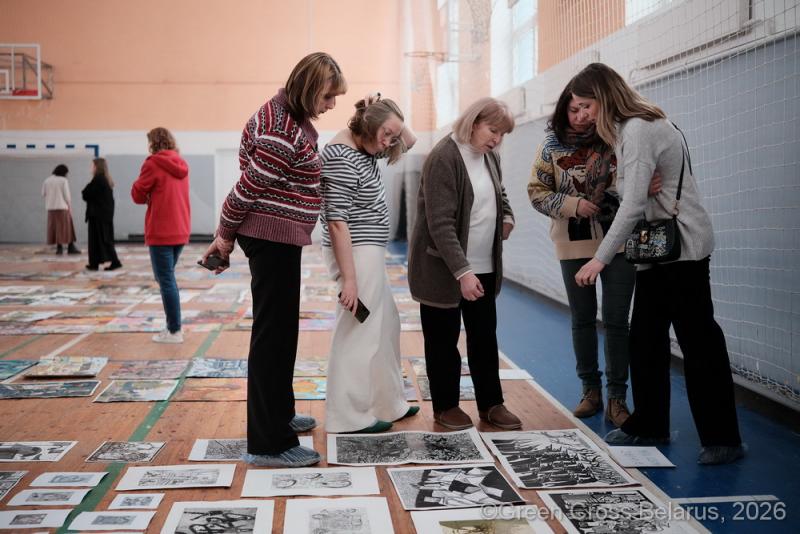 The viewing was open, and all the artists and teachers who attended it were able to get a comment from the jury members if they found any of the selections controversial. Observers also commented on their mini-exhibitions, noting what they relied on when choosing works. In particular, Alyona Frolova, a specialist at the Far Eastern Art Museum, explained her choice by the emotional response from the work, Elena Leontieva, an artist-teacher from Karelia, drew attention to the pink color in the works, Anna Vygonnaya, a restorer from Minsk, made a selection of insect images, and animators Anna and Mikhail Tumelya were attracted by stories and plots. The first day ended with an introduction to the Minsk State Art College named after A.K.Glebov.
The next two days were devoted to discussing the specifics of online exhibitions of art works, different practices of teaching art history, the peculiarities of teaching photography in a situation of universal accessibility of photographic technologies and various approaches to evaluating children's creative works.
The second day of the conference began on February 6 with some results of the three contests "In My Homeland" in 2026, which were presented by Elena Popova, Deputy Director of the Green Cross Belarus NGO (GCB). She supplemented her presentation on the number and geography of participants with the most striking examples of stamps from the collection collected during the project.
Yulia Bryakina, Deputy Director for Academic Affairs of the V.E. Tatlin Children's Art School No. 1 (Penza), opened the section on the specifics of online exhibitions of art works. In her speech, she shared her experience of organizing and participating in various competitions, where the first stage is held in an online format. This approach makes participation more accessible and simplifies technical viewing, but at the same time increases the number of low-quality works and may worsen the perception of the original due to the peculiarities of digitization and screen appearance.
The conversation about online exhibitions and on-screen copies turned into a discussion about the forms and format of artwork. Boris Samosyuk, an artist from Ufa, offered his thoughts on this topic. He drew attention to the fact that in different eras different formats were preferred – in antiquity and the Middle Ages – vertical, in later periods of history – horizontal, which was determined by the depicted object (figure or plot). There were also options for combining formats, mainly in monumental painting. After giving a very brief classification of the forms used by artists, Boris Alekseevich noted that everything is very individual in this matter, since any form is one of the ways of artistic expression, which the artist chooses based on the idea, the plot.
Anna Vygonnaya, a restoration artist from Minsk and a permanent expert of the In My Homeland project, continued the conversation on the topic, drawing attention to how important scale, proportionality and conformity to the environment are for the perception of an artwork.
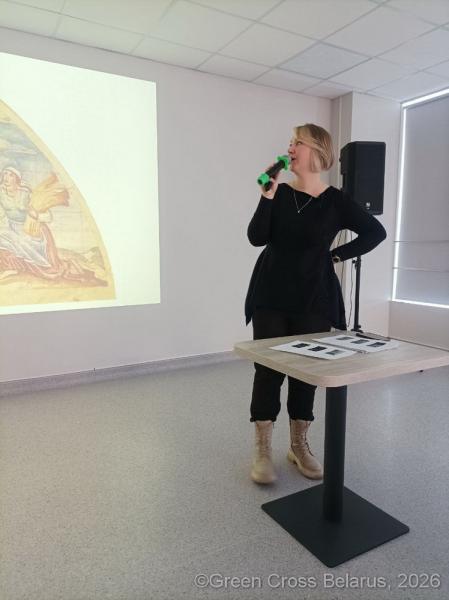 The discussion about the format ended with a speech by Yulia Lisai, a leading researcher at the National Art Museum of the Republic of Belarus, "Mikhas Sevruk: Going beyond the format," in which she not only showed preserved artworks (often only sketches of monumental works) by Mikhail Sevruk, an artist of the Vilna school, but also traced the origins – plot and compositional, and even suggested a version about followers.
A large number of speeches were devoted to the practice of teaching art history. Natalia Tsarik, an art historian from Borisov, spoke about the importance of expanding knowledge in various fields for a better understanding of art. Teacher of the Children's Art School named after J.S. Bach (Baltiysk) Tatiana Korolkova presented the practice of short-term creative activities-projects to study certain topics from the history of art. The importance of direct "communication" with the monument of art was vividly demonstrated by Tatyana Karpova, a teacher at the Minsk State College of Technology and Design, giving as an example her experience in organizing and conducting guided tours for students. Ekaterina Drozd, head of the Creative Art Studio from Brest, presented various forms of knowledge control, including test and game ones. The epigraph to the speeches of Anna Vygonnaya and Ksenia Kolobova (head of the Children's Gallery in Apatity) could be a statement by Confucius: "Tell me and I'll forget, show me and I'll remember, let me try and I'll understand." Their method of studying art history "through the hands", that is, through an individual practical learning of styles, aroused not only interest, but also a lively response from the audience.
The presentations on the evaluation of the artworks were presented the next day, February 7, at the parish house of St. Peter and Paul Cathedral. Tatiana Stepurko, a teacher at the Minsk State College of Art named after A.K. Glebov, told the conference participants about the typification of artistic perception proposed by the Czech artist Vera Roeselova. According to it, there are visual, fantasy, decorative and combined types of artistic perception, and, consequently, expressions, each of which can be attributed to a particular artist. Knowledge of these types can help in the search for teaching methods and evaluative approaches to students.
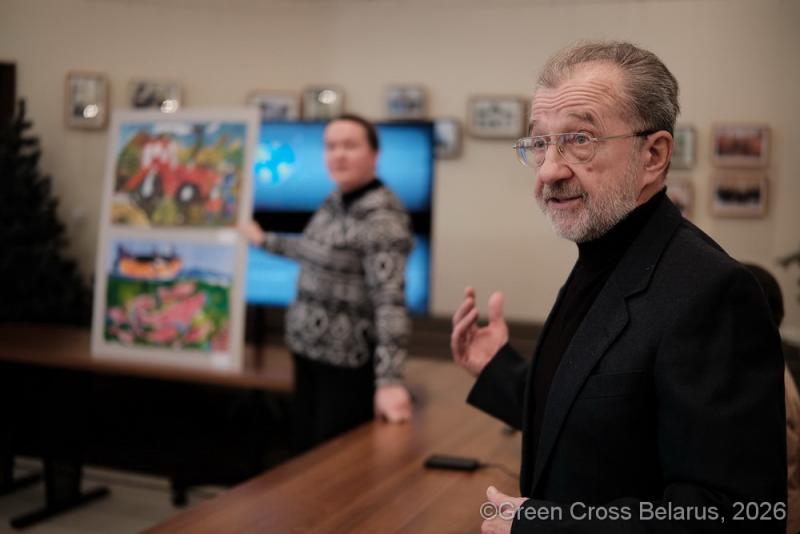 In continuation of the topic, Ivan Klimenko, Associate professor of the Department of the Belarusian State Academy of Arts, shared his experience of participating in the jury of the art competition "Children are friends on the planet". The main idea of his speech was that art is subjective, and therefore the evaluation of art is also subjective. Therefore, despite knowing all the rules of artistic creation, each member of the jury always evaluates the work in his own way, so it is impossible to deduce a certain formula for an absolutely winning work.
A special section at the conference was allocated for photography. Reports on the problems of teaching the art of photography in conditions of universal accessibility of photographic technologies were presented both on February 6 and 7. The block began with the presentation of some of the results of the 4th International Photography Contest "In My Homeland". One of the jury members, photographer Semion Shevtsov, shared the successes and failures of the competition, drew attention to some typical mistakes. Photography teacher Olga Sviridova in her presentations showed by the example of various authors, their searches and experiments, what kind of photography can be, and told how she works with schoolchildren in the Vzglyad photo studio. Pavel Osipov, a researcher photographer and member of the Belarusian Union of Photographers, offered a brief insight into the history of Belarusian photography, and Victoria Lokteva, a methodologist at the Institute of Professional and Amateur Photography, got acquainted with the training program for photography teachers.
The conference ended with a viewing of the best works of the 11th International Contest of Animation.
A guided tour of St. Peter and Paul Cathedral with the head of restoration work and a visit to the National Art Museum of the Republic of Belarus were a methodological addition to the conference.
As a result of all the discussions, the jury decided to draw up a resolution based on the results of the work with recommendations for the organizers and participants of the project "In My Homeland".